True Strength Index (TSI) Technical Analysis & TSI Signals
Trend Strength Indicator - True Trend Indicator
Developed by William Blau
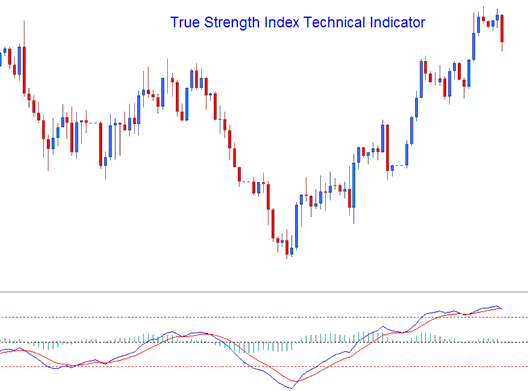
True Strength Index is a momentum indicator. The TSI is plotted by using a momentum calculation that reacts faster and is more responsive to price changes, making it a leading indicator that follows price action direction closely in the forex market.
The True Strength Index is plotted as a blue line, the indicator also plots a signal line which is plotted as a red line, and these two lines are used to generate crossover signals.
True Strength Index also plots a histogram which shows the difference between the TSI Line and the Signal line. This histogram crosses above or below the center lines, histogram levels above the center line shows a bullish crossover signal, while center line levels below the center line shows a bearish crossover signal.
FX Technical Analysis & How to Generate Signals
The TSI uses various methods to generate trading signals. This forex indicator can be used in the same way as the RSI to determine general trend direction of the currency markets. Overbought and oversold levels can also be shown using TSI. The most common methods of generating trading signals are:
Zero line FX Trading Crossover (Histogram FX crossover not Lines Forex Trading crossover )
- Buy - when the histogram crosses above 0 a buy is generated
- Sell - when the histogram crosses below the 0 a sell is generated
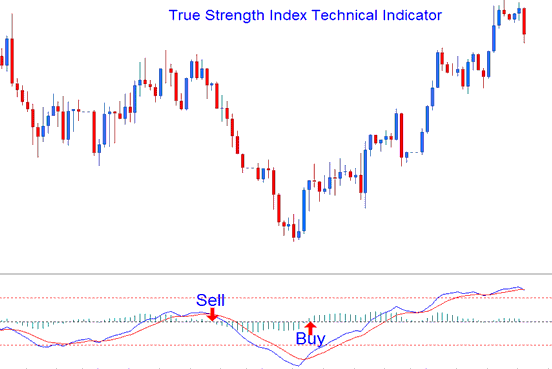
Forex Signal line FX Trading Crossover
- A buy is generated when TSI line crosses above Signal Line
- A sell is generated when TSI line crosses below the Signal Line
This signal is the same as the one above and the timing corresponds to the time when the histogram cross-overs happen.
Forex Divergence FX Trading
Divergence is used to look for potential trend reversal point of a currency pair. Reversal divergence setups are:
Classic Forex Trading Divergence
Classic Bullish Divergence: Lower lows in price and higher lows on the indicator
Classic Bearish Divergence: Higher highs in price and lower highs on the indicator
Divergence trading can also be used in identifying potential trend continuation points in price action direction. The continuation divergence trading setups are:
Hidden FX Trading Divergence
Hidden Bullish Divergence: higher lows in price and lower lows on the indicator
Hidden Bearish Divergence: lower highs in price and higher highs on the indicator
Overbought/Oversold Levels on Indicator
This can be used to identify overbought & over-sold conditions in price action movements.
- Overbought condition - levels being greater than the +25 level
- Oversold condition - levels being less than the -25 level
Trades can be generated when TSI crosses these levels.
Buy signal - when the levels cross above -25 level a buy is generated.
Sell signal - when the areas cross below +25 level a sell is generated.
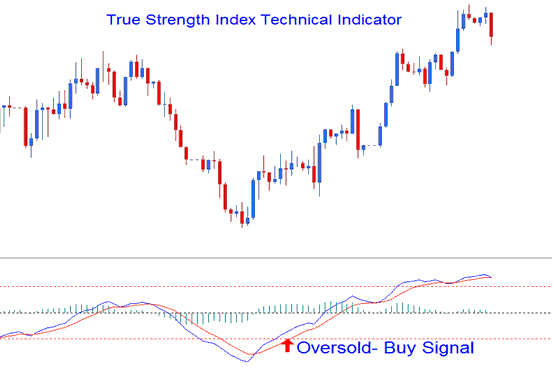
Oversold - Buy Signal
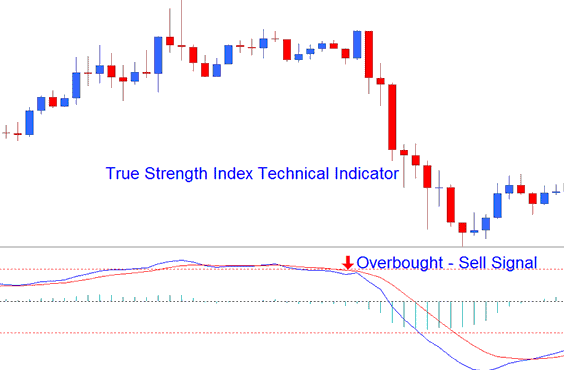
Overbought - Sell Signal
The overbought/oversold levels are indicated using horizontal lines plotted at the +25 and -25 levels.
