Stochastic Momentum Index CFD Technical Analysis and Stochastic Momentum Index CFD Signals
Developed by William Blau.
The Stochastic Momentum Index, SMI indicator is an adaptation of the classic Stochastic Oscillator indicator which smoothes out the stochastic oscillations.
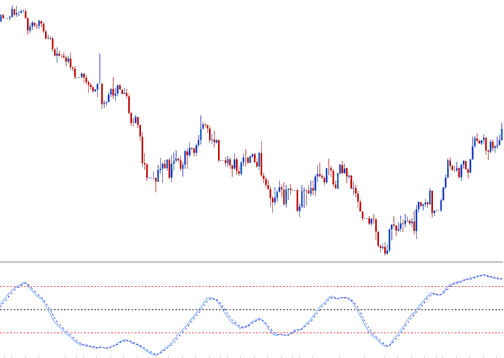
Construction of Stochastic Momentum Index Technical Indicator
This cfds technical indicator is calculated by comparing the cfd price relative to the average of an n number of periods.
Then instead of plotting these values directly, smoothing using an Exponential Moving Average is applied and then the values drawn to form the SMI.
When the closing cfd price is greater than the average of the range, the SMI will move up.
When the closing cfd price is less than the average of the range, the SMI will move downwards.
This oscillator ranges between the values of +100 & -100, this indicator is also less prone to whipsaws compared to the stochastic oscillator.
CFD Technical Analysis and Generating CFDs Signals
Buy & Sell CFD Signals/ Crossover Signals
The Stochastic Momentum Index can be used to generate buy & sell signals using the technique shown below, Buy when the SMI is heading upward & sell when its moving downwards.
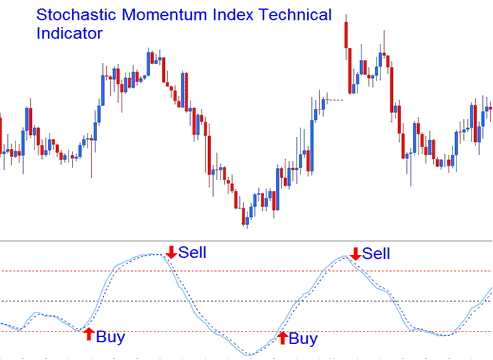
Buy & Sell CFD Signals/ Crossover Signals
Overbought/Oversold Level CFD Trading Crossovers
- Overbought levels above +40
- Oversold levels below -40
Buy trading signal is generated when this oscillator falls below over-sold level & then rises above this level and starts to move upwards.
Sell CFD Signal is generated when this oscillator rises above overbought level and then falls below this level and starts to move downwards.
Divergence CFDs
The example explained and illustrated below shows a bearish classic divergence between the cfd price and the SMI. When the Stochastic Momentum Index showed this divergence the cfd price trend reversed and started to move in a downward direction.
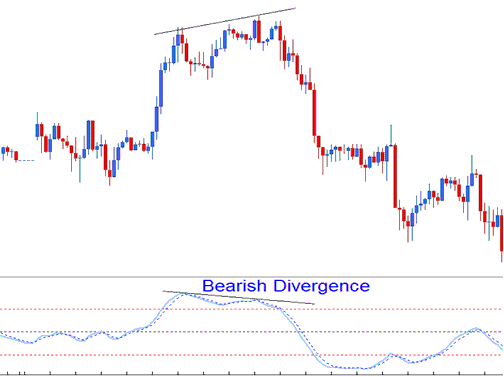
Bearish CFD Trading Divergence