Forex Money Management Styles and Money Management Methods in Forex Trading - Forex Trading Account Management
Best way to practice successful money management in forex trading is for an investor to keep losses lower than the profits they make. This is called risk to reward ratio.
High Risk to Reward Ratio - Forex Account Management Methods
This risk:reward ratio method is used to increase the profitability of an investment strategy by trading only when you have the potential to make more than 3 times more on a forex trade than what you are risking on that trade.
If you invest using a high risk reward ratio of 3:1 or more, you significantly increase your chances of becoming profitable in the long run. FX Chart below shows you how:
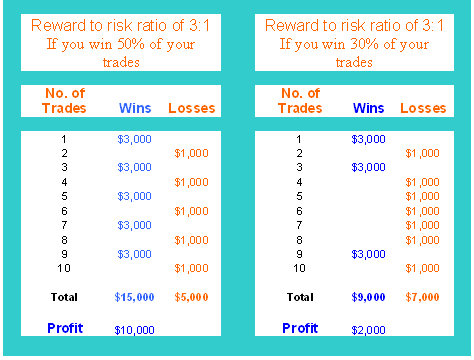
In the first forex example, you can see that even if you only won 50% of your forex trade transactions in your forex account, you would still make a profit of $10,000.
Even if your win rate went lower to about 30% you would still end up profitable - Forex Trading Account Management Principle - Forex Money Management.
Just remember that whenever you have a good risk to reward ratio, your chances of being profitable as a trader are much greater even if you have a lower win percentage for your forex trading strategy.
Never use a risk : reward ratio where you can lose more pips one forex trade than you plan to make on that trade. It does not make sense to risk 1,000 dollars in order to make only 100 dollars.
Because you have to win 10 times more to make the 1,000 dollars back. If you ONLY lose once you have to give back all your forex trading profits for all your 10 trades.
This type of investment strategy makes no sense & you will lose on the long term.
Percentage Risk Method - Forex Account Management Methods
The percent risk method is a method where you risk the same percentage of your forex account balance per every single trade transaction - Forex Trading Account Management Techniques.
Percentage risk based money management method says that there will be a certain percentage of your forex account equity balance that is at risk per trade. To calculate the percent risk per each forex trade transaction, you need to know two things, the percentage risk that you've chosen and forex lot size of an open forex order so as to calculate where to put the stop loss order. Since the risk percent is known, we shall use it to calculate the lot size of the forex trade order to be placed in the forex market, this is known as position size.
Example
If you have an account balance of $50,000 in your forex account and the risk percent you use is 2%
Then 2 % is equal to $1,000
If three investors buy EURUSD and the first one is using 20 pips stop loss, second one is using 40 points stop loss, third one is using 50 points stop loss, their forex trade position size will be:
Example 1:
Stop loss = 20 pips
Risk percent = 2 % = $1,000
20 pips = $1,000
1 point =1,000/20= $50
Position size is 5 lots (for 5 lots 1 point movement =$ 50)
Example 2:
Stop loss = 40 pips
2 % = $1,000
40 pips = $1,000
1 point =1,000/40= $25
Position size is 2.5 lots (for 2.5 lots 1 point movement =$ 25)
Example 3:
Stop loss = 50 pips
2 % = $1,000
50 pips = $1,000
1 point =1,000/50= $20
Position size is 2 lots (for 2 lots 1 point movement =$20)
Example: If an investor with $50,000 wants to calculate annual income from his strategy
Annual income: If your forex trading system has a win ratio of 70% and your risk reward is 3:1, and your stop loss is 30 pips and take profit is 90 pips and every month you make 20 transactions trading forex standard lots, then you maximum annual income will be about:
For 1 standard lot profit per 1 pip is $10
20 transactions*12 months = 240 transactions
Wins and Profit
70% win : 70% of 240 = 168 profitable transactions
168 transactions * 90 pips = 15, 120 pips
15, 120 pips = $151,200
Losses
30% win : 30% of 240 = 72 losing trade transactions
72 transactions * 30 pips = 2, 160 pips
2, 160 pips = $21,600
Net Profit = 15, 120 - 2, 160 = 12, 960 pips
Income: 12, 960 pips = $129,600
The above is just an example, the amount you will make will depend on the risk: reward ratio of your Forex trading system along with it's win percentage ratio.
Other factors to consider include:
Maximum Number of Open Forex Trade Positions
A final point to consider is the maximum number of open forex trade positions that is the maximum number of forex trades that you want to be in at any one given time. This is another factor to decide when managing forex account capital.
If for examples, you chose a 2 %, you may also say chose to be in a maximum of 5 forex trade positions at any one given time. If you open 4 trade positions & all 4 of those positions close at a loss on the same day, then you would have an 8% decrease in your account balances that day.
Invest Sufficient Capital
One of the worst mistakes which traders can make in forex trading is attempting to open a forex account without sufficient capital.
The forex trader with limited trading capital will be a worried trader, always looking to minimize trading losses beyond the point of realistic trading, but will also be oftenly taken out of the forex trade transactions before realizing any success out of their forex trading strategy.
- Exercise Discipline
Discipline is most important thing which a trader can master to so as to become profitable. Discipline is the ability to plan your work and work your plan.
It is the ability to give a forex trade the time to develop without hastily taking yourself out of the market simply because you are uncomfortable with risk. Discipline is also the ability to continue to stick to your forex trading plan even after you have suffered losses. Do your best to cultivate the level of discipline that is required so as to be profitable.
Managing Forex Account Capital Basics - Forex Trading Account Management Basics
Money management, is the foundation of any forex trading system as it helps investors to improve their chances to get profits when trading on the FX market. It is especially important when transacting in the leveraged forex currency trading market, which is considered to probably be one of the more liquid financial markets but at the same time also a trader of the riskiest.
If you want to invest successfully in the forex trading market you should realize that it is very important to have an effective forex trading strategy of money management because you will be using leverage to place your forex orders - Forex Trading Account Management Basics.
The difference between average profits & losses should be strictly calculated, the profits on average should be more than the losses on average when trading, otherwise forex trading will not yield any profits. In this case an investor has to formulate their own forex trading account management rules, success of each person depends on their own individual traits. Therefore, every trader makes his own forex strategy & formulate their own money management rules based on the above guidelines.
When you are placing your forex orders put your stop loss orders in order to avoid huge losses. Stop loss orders can also be used to lock in profit.
Consider the chance to get profit against chance to get loss as 3:1 - this risk: reward ratio should be favorable more on the profit side.
Considering these forex trading rules and guidelines, you can use them to improve profitability of your forex strategy & try to develop your own forex strategy that will possibly give you good profits when trading with it.