Commodity Trading Leverage & Margin Trading Explanation & Examples
Margin required : It is amount of money your commodity broker requires from you to open a position. It is expressed in percents.
Equity : It is the total amount of capital you have in your account.
Used margin : amount of money in your trading account which has already been used up when buying a commodity trading contract, this contract is one that is displayed in open trade positions. As a trader you can't use this amount of money after opening a trade order transaction because you have already used it and it is not available to you.
In other words, because your commodity broker has opened up a position for you using the capital you have borrowed, you must maintain this usable margin for your account as a security to allow you to continue using this commodity leverage he has given you.
Free margin : amount in your account which you can use to open new trades. This is amount of money in your account which has not yet been commodity trading leveraged because you have not yet opened a trade with this money - this is also very important for you as a trader because it enables you to continue holding your open trade transactions as explained and illustrated below.
However, if you over use commodities trading leverage, this free margin will drop below a certain percent at which your commodities broker will have to close all your positions automatically, leaving you with a big loss. Commodities broker at this point closes all your open trade position because if your open positions are left open they would lose the money that you have borrowed from them.
This is why you should always make sure you've a lot of free margin. To do this never trade more than 5 percentage of your commodities account, in fact 2 percentage is recommended.
Difference Between Commodity Leverage Set by the Broker and Used Commodities Trading Leverage
If the set commodity leverage is 100: 1, it means you can borrow up to 100 dollars for every 1 dollar you've, but you do not have to borrow all of the 100 dollars for every 1 dollar you have, but you can decide to borrow 50:1 or 20:1. In this case even though the leverage ratio option set 100:1 your used commodity trading leverage will be the 50:1 or 20:1 that you have borrowed to make a trade.
Example:
You have 1000 dollars (Equity)
Set 100:1
Commodity Leverage Used = Amount used /Equity
If you buy commodity lots equal to 100,000 dollars you will have used
= 100,000/1000
= 100:1
If you buy commodity trading lots equal to 50,000 dollars you will have used
= 50,000/1000
= 50:1
If you buy commodity trading lots equal to 20,000 dollars you will have used
= 20,000/1000
= 20:1
In these 3 cases you can see that even though the set is 100:1
The used is 100:1, 50:1, 20:1 depending on the size of commodity lots traded.
So Why not Just Select 10:1 option as the Maximum Commodity Trading Leverage? Because to keep within proper risk management rules it's even recommended that traders use less than this?
This question might seem straight forward but it is not, because when you trade you use borrowed money known A.K.A. Commodity Leverage. When you borrow capital from anyone or a bank you must maintain a security or collateral to acquire a loan, even if the security is based on monthly deduction from your salary, the same thing with Commodity Trading.
In commodity trading the security is known as margin. This is capital you deposit with your broker.
This is calculated in realtime as you trade. To keep your borrowed money you must maintain what is known as the required capital (your deposit).
Now if Your Commodities Trading Leverage is 100:1
When trading if you have $1,000 & use option 100:1 and buy 1 standard lot for $100,000 your margin on this transaction is $1000 dollars in your account, this is money that you will lose if your open trade goes against you the other $99,000 that is borrowed, they will close the open commodity trade transactions automatically once your $1,000 has been taken by the commodities trading market.
But this is if your commodity broker has set 0% Commodities Margin Requirement before closing your commodities trades automatically.
For 20% requirement before closing your commodities trades automatically, then your trades will be closed once your account balance gets to $200
For 50% requirement of this level before closing your commodities trades automatically, then your trades will be closed once your account balance gets to $500
If they set 100% requirement of this level before closing out your open trade positions automatically, then your trade will be closed once your account balance gets to $1,000: Meaning the trade will close-out as soon as you execute it because even if as a trader you pay 1 pip spread your trading account balance will go to $990 & the needed percent is 100% i.e. 1,000 dollars, therefore your orders will immediately get closed.
Most brokers do not set 100% requirement, but there are those who set 100% are not suitable for you at all, select those set 50% or 20% margin requirements, in fact, those commodity brokers that set at 20% are some of the best because the likely hood they close-out your trade is reduced as displayed in example above.
To know about this level which is calculated by your platform automatically - The MT4 Commodity Trading Platform will display this as "Commodities Trading Margin Requirement", This will be displayed as a percentage the higher the percent the less likely your trades are to get closed.
For Example if
Using 100:1
If commodity leverage is 100:1 and you transact commodity lots equal to $10,000
$10,000 dollars divide by 100:1, used capital is $100
Calculation:
= Capital Used * Percentage(100)
= $1,000/$100 * Percentage(100)
Commodities Margin Requirement = 1,000 %
Investor has 980% above the required amount
Using 10:1
If commodity leverage is 10:1 and you transact commodity lots equal to $10,000
$10,000 dollars divide by 10:1, used capital is $1000
Calculation:
= Capital Used * Percentage(100)
= $1,000/$1000 * Percent(100)
Commodities Trading Margin Requirement = 100 %
Investor has 80% above the required amount
Because when a trader has a higher commodity leverage means that they have more percentage above what is required(A.K.A. More "Free Commodities Trading Margin") their open commodity trading transactions are less likely to get closed. This is reason why traders will choose the option 100:1 for their trading account but according to their risk management rules, these traders will not trade above 5:1.
These Areas are Shown on The Software Image Below as an Examples:
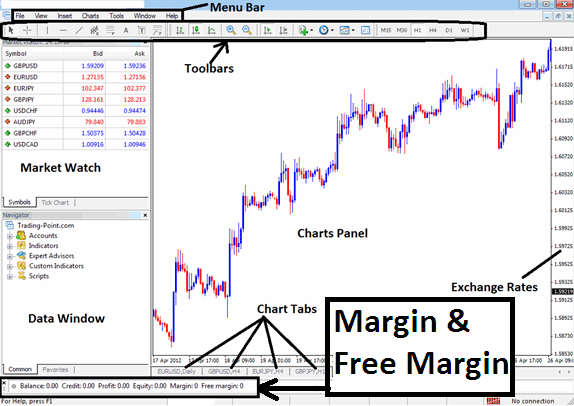
MetaTrader 4 Commodities Trading Software