Trading Stocks Choose a Stop Loss Stocks Order
How to choose you stop loss level the target stop loss should be based on various strategies depending on your type of stocks method.
The three methods of choosing stop loss levels are:
Strategies and Techniques of Setting Stop Loss Stocks Orders In Stock
Traders using a stock system must have mathematical calculations that reveal where the order must be placed.
A trader can also place a stoploss order according to the technical indicators used to set these orders. Certain technical indicators use mathematical equations to calculate where the stoploss order should be set so as to provide an optimal exit point. These technical indicators can be used as basis for setting these orders.
Traders also place these orders according to a predetermined risk to reward ratio. This method of setting is dependent upon certain math equations. For example a ratio of 50 pips stop-loss can be used by a trader if the trade has potential to make 100 pips in profit: this is a risk:reward ratio of 2:1
Other traders just use a predetermined percent of their total stocks account balance.
To set a stop-loss it is best to use one of the following techniques:
1. Percentage of Stocks account balance
This stop-loss setting method is based on the percent of account balance that the trader is willing to risk when trading.
If a trader is willing to risk 2% of account balance then the trader decides how far he will set the stop loss order level based on the trade size which he has bought or sold.
Example:
If a trader has a $10,000 stock trading account and is willing to risk 2 %
- If the trader buys 1 mini contract
1 pip = $1
Then setting at 2%
2% is $ 200
2. Setting Stop Loss Stocks Orders using Support & Resistance Areas
Another way of setting stock trading stop loss orders is to use supports and resistance levels, on the stocks charts.
Given that stoploss orders tend to congregate at key points, when one of these levels is touched by the stocks price, other stock trading orders are set off. Stop loss orders tend to accumulate just above or below the resistance or support levels, respectively.
A resistance or a support area should act like a barrier for the stocks price movement, this is why they are used to set stop losses, if this barrier is broken the stocks price movement can go towards the opposite direction of the original stocks trade, but if this barriers (support and resistance levels) are not broken the stocks price will continue moving in intended direction.
Stop Loss Stocks Order Level Setting using Resistance Level
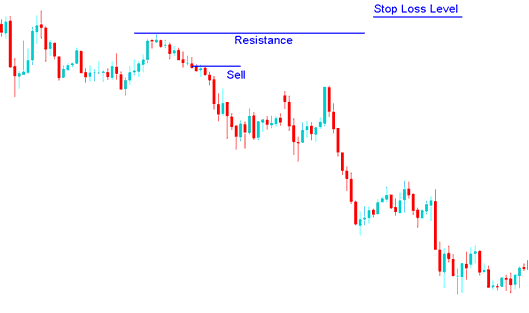
Setting stop loss order above the resistance level
Stop Loss Stocks Order Level using Support Level
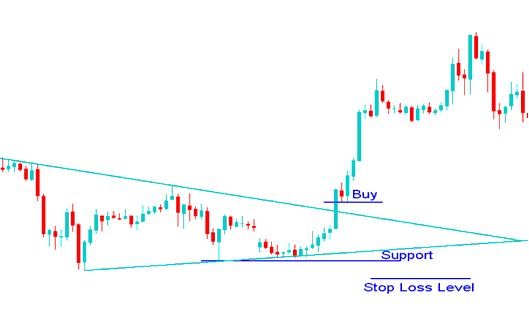
Setting stop loss order below the Support Level
3. Stock Trend Lines
A stock trading trendline can be used to set stop losses where the stop-loss order is set just below the trend line. As long as the trend line holds the trader will be able to continue making profits while at the same time set this stop-loss order which will lock his profit once the trend line is broken.
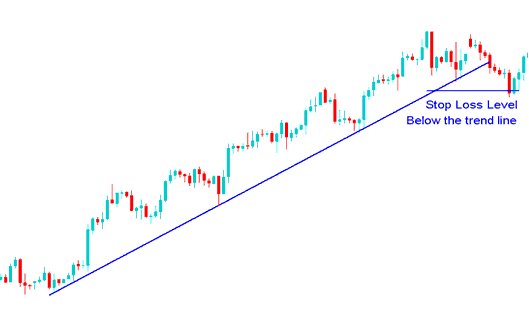
Setting stop loss order below the trendline
Example of where to set this stop loss order using stock trading trend lines.