Money Management in Indices
In indices trading one of the most crucial concepts is money management; how do you as a trader manage your Indices account so that you make profits in the long term.
To know about money manage you're required to know the following concepts as a trader.
Drawdown
Drawdown is the amount of money you can lose on a single trade in indices trading.
Example of Drawdown:
As a trader if you have $10,000 dollars in your account & you open a trade, & the trade makes a loss of $1,000 dollars from one single trade your drawdown is:
Drawdown = $1,000/$10,000*100 = 10% of your account
Maximum Drawdown
Maximum drawdown is the total amount you have lost in your account before you begin making profits.
Example of Maximum Drawdown:
As a trader if you have $10,000 dollars in your account & you open a 3 losing trades of a total of $3,000 before making 4 winning trades of $4,000, then your maximum drawdown is:
Maximum Drawdown = $3,000/$10,000*100 = 30% of your account
To better manage your money as trader it is best to keep this drawdown per trade to a minimum. The recommended is 2 % draw down per trade. This way as a trader you will control the risk per trade and also minimize the maximum drawdown.
For Example if there are two traders one uses 2 % drawdown per trade and the other uses 10 % drawdown per trade, if both of them make 15 losing trades in a row, then the 2 accounts will be as shown below:
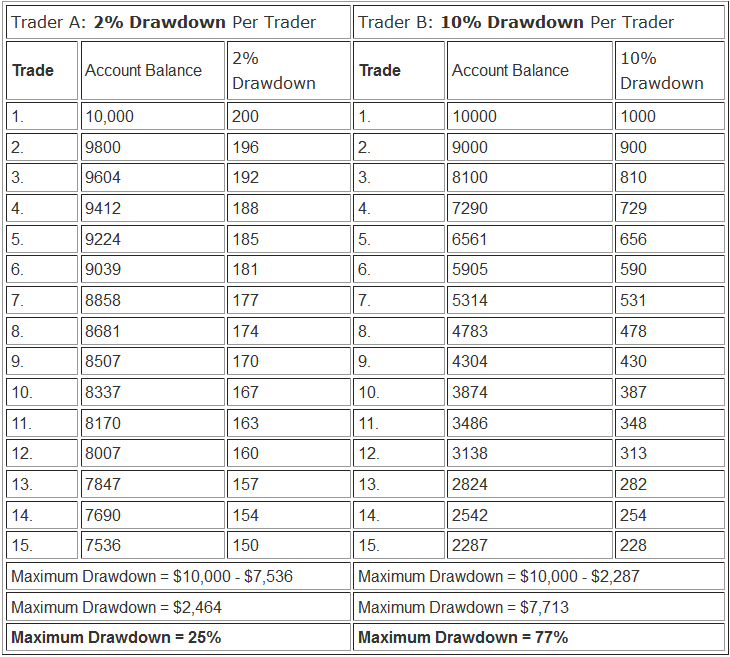
After 15 losing trades a trader using 2 % drawdown would still have 75% of their total capital, while a trader using 10% drawdown would only have 23% of their total capital.
This illustration although it is nearly not possible to have a losing streak of 15 consecutive trades in a row, shows that using 2 % drawdown will preserve your capital and help keep you in this trading game for longer & you'll be more likely to make profits in the long term.
This is also because it'll be easier to break even if you only lose a little of your capital rather than losing most of your capital, as is illustrated below:
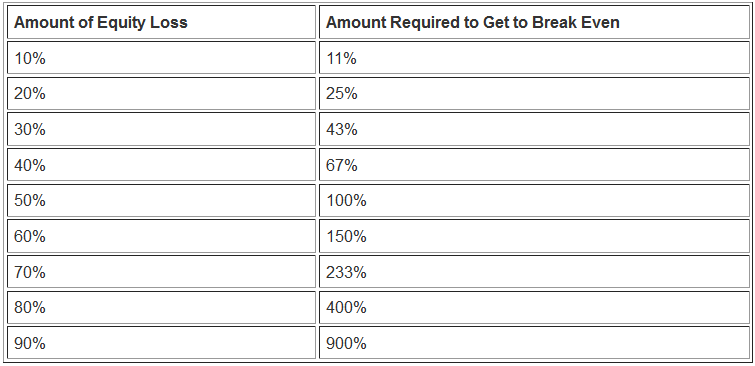
The way break even is calculated in terms of percent is:
10 % loss for $10,000 your capital is $9,000 you need to make $1,000 to get to $10,000
Therefore $1,000/$9,000*100 = 11%
30 % loss for $10,000 your capital is $7,000 you need to make $3,000 to get to $10,000
Therefore $3000/$7,000*100 = 43%
70 % loss for $10,000 your capital is $3,000 you need to make $7,000 to get to $10,000
Therefore $7000/$3,000*100 = 233%
From these examples above the more the maximum drawdown the harder it is to get back to break even and to make profits.
This is why it is best to use 2 % risk drawdown so as to keep your drawdown and maximum drawdown to a minimum and this way improve your chance of making profits in the Stock Indices market.
