Bollinger Band Trading Indicator Bulge and Squeeze Technical Analysis
The Indices Bollinger Band are self adjusting which means the bands widen and narrow depending on Indices price volatility.
Standard Deviation is the statistical measure of the Indices price volatility used to calculate the widening or narrowing of the Indices Bollinger bands. Standard deviation will be higher when Indices prices are changing significantly & lower when the Indices market prices are calmer.
- When Indices price volatility is high the Bollinger Band widen.
- When Indices price volatility is low the Bollinger Band narrows.
The Bollinger Band Squeeze - How to Stock Indices Trade Bollinger Band Squeeze
Narrowing of Stock Indices Bollinger Band is a sign of Stock Indices price consolidation and is known as the Bollinger band squeeze.
When the Bollinger Band Stock Indices indicator show narrow standard deviation it's usually a time of Stock Indices price consolidation, & it's a Indices trading signal that there will be a Indices price breakout & it shows Stock Indices traders are adjusting their trade positions for a new move. Also, longer the Indices prices stay within the narrow bands the greater the chance of a Indices price breakout.
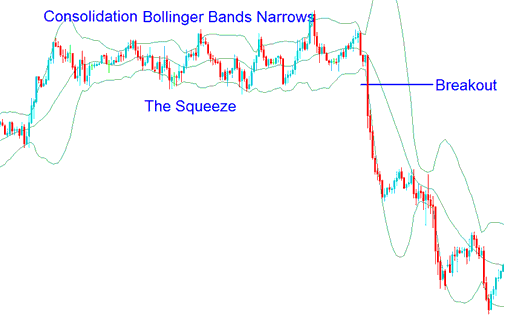
Bollinger Squeeze - How to Stock Indices Trade Bollinger Band Squeeze
The Bollinger Bulge - How to Stock Indices Trade Bollinger Band Bulge
The widening of Bollinger Band is a sign of a Indices price breakout & is known as the Bollinger Band Bulge.
Bollinger Band that are far apart can serve as a Indices trading signal that a Indices trend reversal is approaching. In the Bollinger bands Stock Indices indicator example below, Indices Bollinger bands get very wide as a result of high Stock Indices price volatility on the down swing. The Indices trend reverses as prices reach an extreme level according to statistics & the theory of normal distribution. The "bulge" predicts the change to a Indices downtrend.
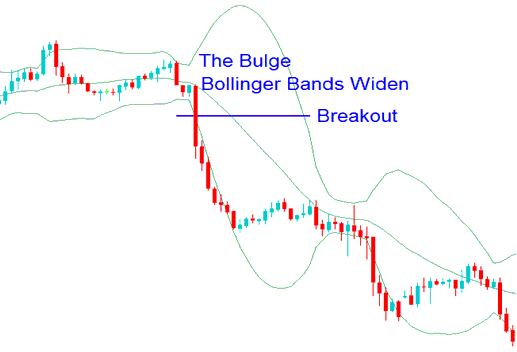
Bollinger Bulge - How to Stock Indices Trade Bollinger Band Bulge
