Support and Resistance Levels
This is one of the most widely used concepts in gold trading and it refers to levels on a xauusd chart that tend to act as barriers that prevent the gold price of an asset from getting pushed beyond a certain point in a particular direction.
Support
This level prevents the gold price of an asset from getting pushed downwards and therefore it is regarded as the floor because it prevents the xauusd market from moving downwards past a certain point.
Example:
On the xauusd example shown below you can see that gold price moved down until it hit a support
Once gold price hit this level it slightly bounced back up, then resumed going down until it hit the support again.
This process of hitting a level and bouncing back is called testing the support.
The more times a support is tested and the xauusd market bounces up the stronger it is - the xauusd example shown below this level was tested three times without breaking. Finally the xauusd market xauusd trend reversed and started moving in opposite direction.
Once this level has been determined traders use it to place their xauusd orders to buy the gold at the same time putting a stop loss a few pips below it.
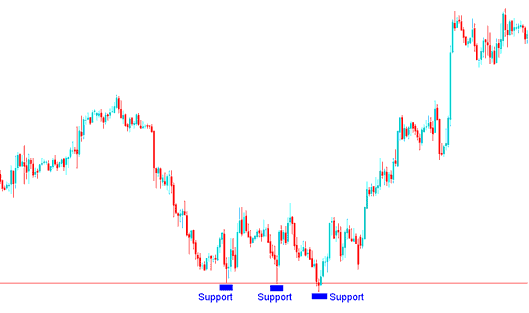
In the xauusd example above the xauusd market did not move below this area. It is an area where gold price cannot break lower.
These regions form good points where gold price trend in a downward trend is likely to reverse and get support and start moving upwards.
The demand to buy the gold at this point will be greater and therefore providing a good point to begin a buy xauusd trade, while placing stops some pips just below.
This support is also use by short xauusd sellers as a target where to set their take profit for their short sell gold trades.
This is another reason why the xauusd trend is likely to reverse or consolidate at this level because once the sellers close their sell gold trades then momentum of the downward xauusd trend reduces and a consolidation will happen after which the direction is likely to reverse.
Resistance
This level prevents the gold price of an asset from getting pushed upwards these levels are therefore regarded as the ceiling because these levels prevent the xauusd market from moving upwards
Example:
On the xauusd example shown below you can see that gold price moved up until it hit a resistance.
Once gold price hit this level it retraced slightly the resumed going up until it hit the resistance again.
The resistance holds & is tested five times without breaking.
The more times a resistance area is tested the stronger the it is.
Once this level has been determined traders put their xauusd orders to sell at this level and at the same time putting a stop loss a few pips above it.
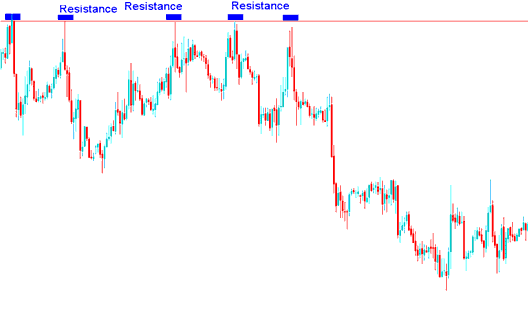
In the xauusd example above the xauusd market did not move above this area. This region shows an area where gold price cannot break above.
These levels form good points where a gold price in an upward xauusd trend is likely to reverse after some resistance and start moving downwards in opposite direction.
This shows that the demand to sell the gold at this region will be greater & therefore providing a good point to start a sell xauusd trade, while placing stops some pips just above this level.
This resistance level is also used by buyers as a target where to set their take profit orders for their bullish trades. T
His is another reason why the xauusd trend is likely to reverse or consolidate at this level because once the buyers close their sell gold trades then momentum of the upward trend reduces and a consolidation will happen after which the direction is likely to reverse and start moving down.
