Stochastic Oscillator Technical Analysis & Stochastic Oscillator Signals
Developed by George C. Lane
The Stochastic Oscillator is a momentum indicator - it shows the relation between the current closing price relative to the high and low range over a given number of n periods. The Oscillator uses a scale of 0-100 to plot its values.
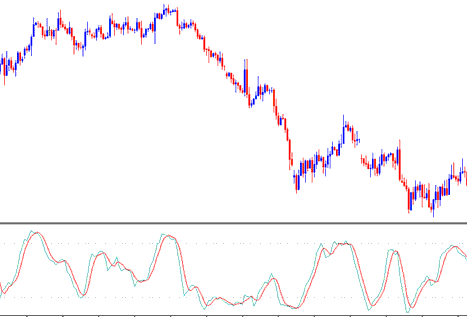
This Oscillator is based on the theory that in an uptrend market the price closes near the high of the price range and in a downwards trending market the price will close near the low of the price range.
The Stochastic Lines are drawn as 2 lines - %K and %D.
- Fast line %K is the main
- Slow line %D is the signal
3 Types of Stochastics FX Trading Oscillators: Fast, Slow and Full Stochastics
There are Three types are: fast, slow & full Stochastic. The three indicators look at a given chart period for examples the 14-day period, & measures how the price of today’s close compares to the high/low range of the time period that's being used to calculate the stochastic.
This oscillator works on the principle that:
- In an uptrend, price tends to close at the high of the candlestick.
- In a downtrend, price tends to close at the low of the candlestick.
This indicator shows the momentum of the Forex trends, & identifies the times when a market is overbought or oversold.
Forex Technical Analysis & Generating FX Signals
The most common techniques used for analysis of Stochastic Oscillators to generate Forex signals are cross overs signals, divergence signals & over bought over-sold areas. The following are the techniques used for generating trade signals
Forex Crossover FX Signals
Buy signal - % K line crosses above %D line (both lines heading upwards)
Sell signal - %K line crosses below the %D line (both lines heading downwards)
50-level Crossover:
Buy signal - when stochastic lines cross above 50 a buy trading signal is generated.
Sell signal - when stochastic lines cross below 50 a sell signal is generated.
Forex Divergence FX Trading
Stochastic is also used to look for divergences between this indicator and the price.
This is used to determine potential Forex trend reversal signals.
Upwards/rising trend reversal - identified by a classic bearish divergence
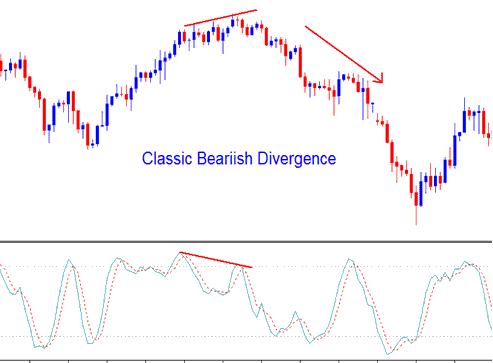
Trend reversal - identified by a classic bearish divergence
Downwards/descending trend reversal - identified by a classic bullish divergence
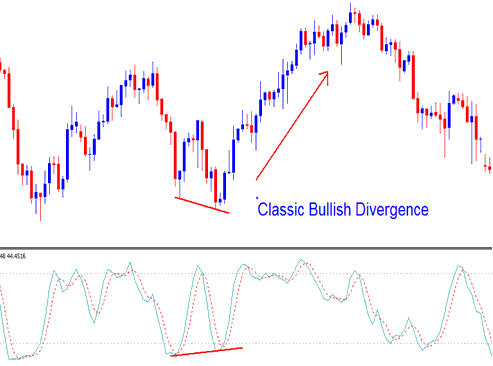
Trend reversal - identified by a classic bullish divergence
Overbought/Oversold Levels on Technical Indicator
Stochastic is mainly used to identify potential overbought & over-sold conditions in price movements.
- Over-bought values greater than 70 level - A sell signal occurs when the oscillator rises above 70% and then falls below this level.
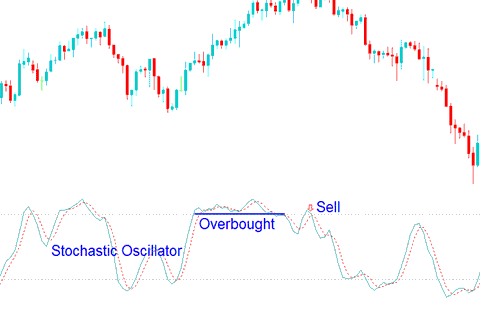
Overbought - Values Greater 70
- Over-sold values less than 30 level - a buy signal is generated when the oscillator goes below 30% & then rises above this level.
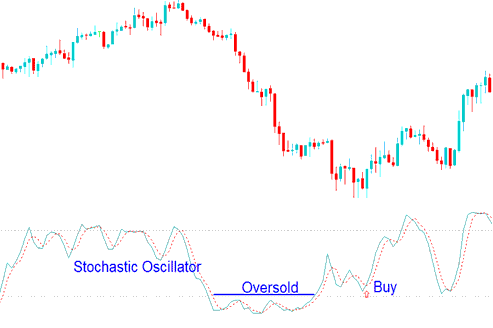
Oversold - Values Less Than 30
Trades are generated when the Stochastic Oscillator crosses these levels. However, overbought/oversold levels are prone to whipsaws especially when the forex market is trending upward or downward.
