Combining Stochastics with Different Types of Technical Gold Indicators
This tutorial should be called: Combining Stochastics with other Technical Indicators, but Stochastic XAUUSD System sounds real nice.
Stochastic Oscillator technical indicator can be combined with other indicators to form a xauusd system. For our example we will combine it with:
- RSI
- MACD
- Moving Averages Gold Trading Technical Indicator
Example 1: XAUUSD Trading Stochastic System
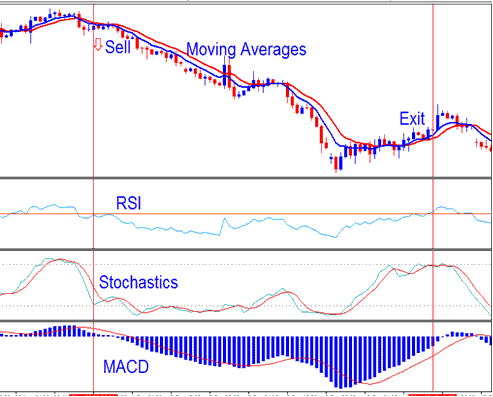
Sell XAUUSD Signal Generated using XAUUSD Trading Stochastic System
From our xauusd system the sell signal is generated when:
- Both Moving Averages are moving down
- RSI is below 50
- Stochastic moving downward
- MACD heading downwards below centerline
Sell signal was generated when all these xauusd rules were met. The exit xauusd signal is generated when a trading signal in opposite direction is generated i.e. When the technical indicators reverse.
The good thing about using such a xauusd system is that we are using different types of xauusd indicators to confirm the trade signals & avoid as many xauusd whip-saws as possible in process.
- Stochastic - is a momentum oscillator gold technical trading indicator
- RSI- is a momentum oscillator gold technical trading indicator
- Moving Averages Indicator- is a xauusd trend following gold technical trading indicator
- MACD- is a xauusd trend following gold technical trading indicator
It is very useful to combine more than one xauusd indicator, as a combination of xauusd trading signals is better than relying on just a single xauusd technical indicator. The gold technical trading indicator combinations reinforce each other, and cancel out false whipsaw gold trade signals.
A xauusd trend following technical indicator helps a trader to see the overall picture, while using more than one momentum xauusd technical indicator gives better & more reliable entry and exit points for trading xauusd.
The xauusd indicators combinations & their xauusd signals help to decipher a lot of the xauusd market activity.
Example 2: XAUUSD Trading Stochastic System
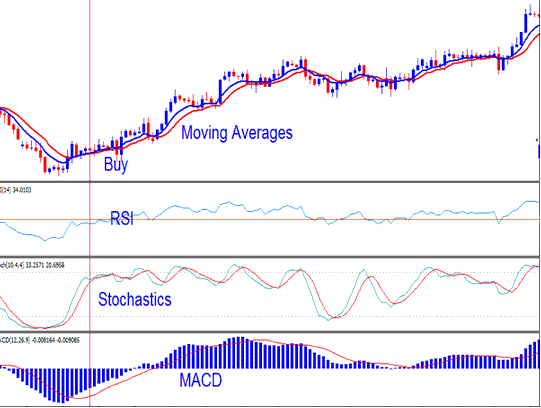
Buy XAUUSD Signal Generated using XAUUSD Trading Stochastic System
For this example the xauusd trend is clearly upward, but at some point there were a few xauusd whipsaws generated by the stochastic oscillator xauusd indicator, can you spot them? - So the question is how can a trader avoid trading these xauusd whipsaws?
Well, the answer is that by looking at the other technical xauusd indicators such as MACD indicator a trader could have avoided the whip saw, even the MACD technical indicator had not given a cross-over xauusd trading signal although it was very close to the zero center line level, at the same time the gradient at which the moving averages technical indicators turned was not so sharp as to warrant a decisive xauusd market xauusd trend reversal. Well the thing is that it’s not so obvious when it comes to recognizing xauusd market whipsaws: it's a skill that takes some time but after some time you can spot whipsaws from a mile away.
One tip is that as long as MACD indicator is above zero center-line even if the MACD lines are heading downwards then the trend is still upwards. As you can see from the above example MACD indicator never went below zero line and afterwards the upward trend continued with the MACD indicator maintaining above Zero line and continuing to move upwards.
During ranging xauusd markets Stochastic Oscillator indicator will give the fastest xauusd signals which are prone to whipsaws. This is why stochastic oscillator indicator is best combined with other indicators and the xauusd signals traded are confirmed by another one or two other XAUUSD indicators.
