SMA, EMA, LWMA and SMMA
There are four types of cfd moving averages:
- Simple cfd moving average
- Exponential cfd moving average
- Smoothed cfd moving average
- Linear weighted cfd moving average
The difference between these 4 cfd moving averages is the weight assigned in to the most recent cfd price data.
SMA Indicator
CFD Trading SMA indicator applies equal weight to the cfd data used to calculate the simple moving average and is calculated by summing up the cfd price periods of a cfd chart and this value is then divided by the number of such cfd price periods. For example cfd simple moving average 10, adds the cfd price data for the last 10 cfd price periods and divides them by 10.
EMA Indicator
CFD Trading EMA indicator applies more weight to the most recent cfd price data and is calculated by assigning the latest cfd price values more weight based on a percent P, multiplier that is used to multiply and assign more weight to the latest cfd price data.
LWMA Indicator
CFD Trading LWMA indicator moving averages applies more weight to the most recent cfd price data and the latest data is of more value than earlier cfd price data. Linear Weighted cfd moving average is calculated by multiplying each of the cfd closing cfd prices within the series, by a certain weight coefficient.
SMMA Indicator
CFD Trading SMMA Indicator is calculated by applying a smoothing factor of N, the smoothing factor is composed of N smoothing for N cfd price periods.
The cfd chart example explained and illustrated below shows SMA, EMA and LWMA. The SMMA cfd moving average is not commonly used so it is not shown below.
The LWMA cfd indicator reacts fastest to cfd price data, followed by the EMA and then the SMA.
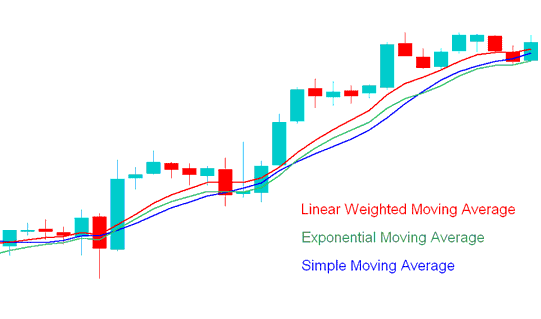
SMA, LWMA, EMA - Types of CFD Moving Averages - SMA, EMA and LWMA
Day CFD Trading with Exponential and Simple Moving Averages
The SMA and EMA cfd moving averages are the most commonly used Moving averages to trade cfd. Whereas the EMA cfd moving average has a more sophisticated method of calculation, its more popular than the SMA cfd moving average.
Simple Moving Average is the arithmetic mean of the closing cfd prices in the cfd price period based on the set time period where each time period is added and then it is divided by the number of time cfd price periods chosen. If 10 is the cfd price period used the cfd price for the last ten cfd price periods added up then it is divided by 10.
SMA cfd indicator is the result of a simple arithmetic average. Very simple and some CFD traders tend to associate with the cfd trend since it closely follows cfd price action.
EMA on the other hand uses an acceleration factor and it is more responsive to the cfds trend.
The SMA cfd moving average is used in cfd charts to analyze cfd price action. If the cfd price action in more than 3 or 4 time cfd price periods the SMA then it's an indication that long cfds trades should be closed immediately and the bullish momentum of the buy cfd trade is waning.
The shorter the SMA cfd price period the faster it is to respond to cfd price change. SMA cfd indicator can be used to show direct information regarding the cfd trend of the cfd market and the strength by looking at its slope, the steeper or more pronounced slope of the SMA is, the stronger the CFD trend.
The Exponential Moving Average is also used by many traders in the same way but it reacts faster to the cfd market moves and therefore it is more preferred by some cfds traders.
The SMA and EMA can also be used to generate entry and exit points when cfd. These Moving averages can also be combined with Fibonacci and ADX indicators to generate confirmation the cfd signals generated by these moving averages.