CFDs Money Management System PDF
Importance of Risk Management in Trading CFDs
In any business, in order to make a cfd trading profit a trader must learn how to manage the risks. To make cfd trading profits in cfd trading you need to learn about the various cfd money management strategies discussed on this learn cfd lesson web-site.
When it comes to cfd, the risks to be managed are potential cfd trading losses. Using cfd trading risk management rules will not only protect your cfd account but also make you profitable in long run.
CFD Money Management Strategies
As cfd traders the number one risk in cfd trading is known as draw down - this is the amount of money you've lost in your cfd trading account on a single cfd trade.
If you have $10,000 cfd capital and you make a cfd trading loss in a single cfd trade of $500, then your cfd trading drawdown is $500 divided by $10,000 which is 5% cfd trading draw down.
CFDs Money Management Strategies
This is the total amount of money you've lost in your cfd trading account before you begin making profitable cfds trades. For example if you have $10,000 in cfd capital and make 5 consecutive losing cfd trades with a total of $1,500 cfd trading loss before making 10 winning cfds trades with a total of $4,000 cfd trading profit. Then the cfd trading maximum drawdown is $1,500 divided by $10,000, which is 15% maximum cfd trading draw down.
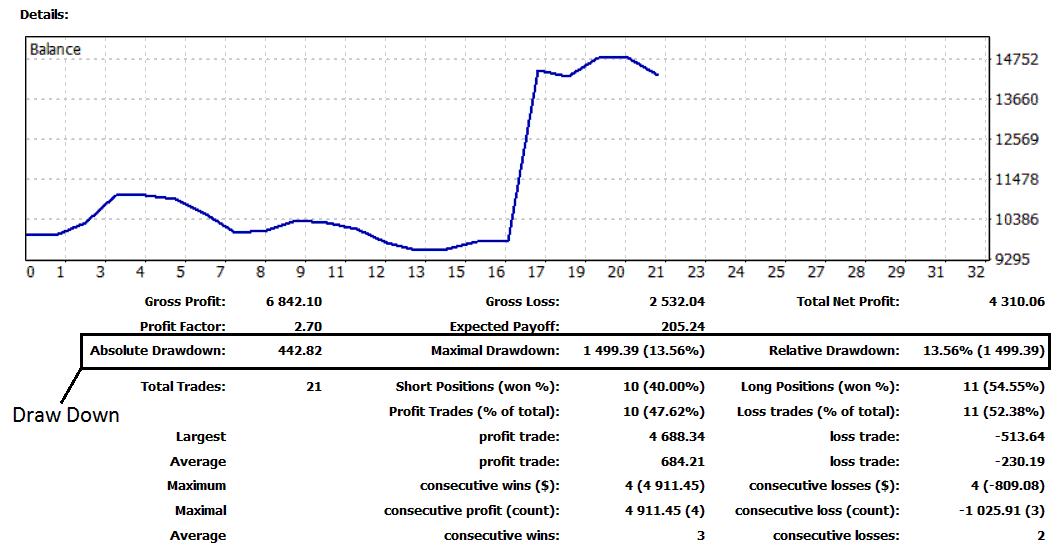
CFD Trading DrawDown is $442.82 (4.40%)
Maximum CFD DrawDown is $1,499.39 (13.56%)
To learn how to generate the above in cfd trading reports using MT4 cfd trading platform: Generate CFD Reports on MT4 Tutorial - CFDs Money Management System PDF - CFD Trading Risk Management Excel Spreadsheet
Importance of Risk Management in Trading CFDs
The in cfds trading examples explained below shows the difference between risking a small percent of your cfd capital compared to risking a higher percent. Good How to Calculate Risk Management CFD Trading principles requires you as a trader not to risk more than 2% of your total cfd account equity on any one single cfd trade.
CFD Percentage Risk Method
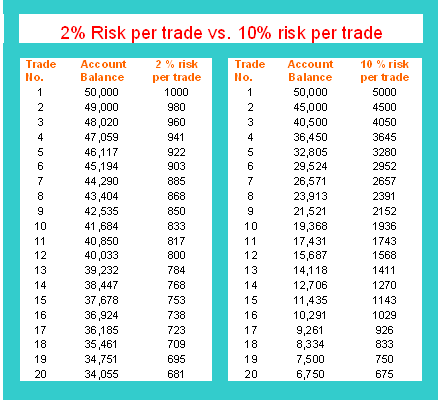
2% & 10% CFDs Money Management Rule - How to Calculate Risk Management CFD Trading - Importance of Risk Management in Trading CFD
There's a big difference between risking 2% of your cfd account equity compared to risking 10% of your equity on a single cfd trade.
If you happened to go through a losing cfd trading streak & lost only 20 cfds trades in a row, you would have gone from starting cfd account balance of $50,000 to having only $6,750 left in your cfd account if you risked 10% on each cfd trade. You would have lost over 87.50% of your cfd account equity.
However, if you risked only 2% you would have still had $34,055 in your cfd account which is only a 32% cfd trading loss of your total cfd account equity. This is why it's best to use the 2% risk management strategy in trading cfd.
The difference between risking 2% and 10% on a single cfd trade is that if you risked 2% you would still have $34,055 in your cfd account after 20 losing trades.
However, if you risked 10% you would only have $32,805 in your cfd account after only 5 losing cfd trades that is less than what you would have in your cfd account if you risked only 2 % of your cfd account & lost all 20 cfd trade transactions.
The point is that you want to setup your How to Calculate Risk Management CFD Trading rules so that when you do have a cfd trading loss making period, you will still have enough in cfd capital to trade next time.
If you lost 87.50% of your in cfd trading capital you would have to make 640% cfd trading profit to get back to break-even.
As compared to if you lost 32 % of your in cfd trading capital you would have to make 47% cfd trading profit to get back to the break-even. To compare it with the cfd trading example 47% is a lot easier to breakeven than 640 % is.
The chart below shows what percentage you would have to make so that you as a trader can get back to breakeven if you were to lose a certain percentage of your in cfd trading capital.
Concept of Break Even - CFDs Money Management System Guide
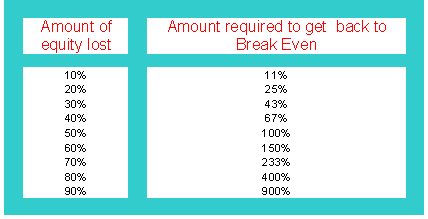
CFD Account Equity and Break Even - CFDs Money Management Strategies Methods - CFDs Money Management System Guide
At 50% cfd trading draw-down, one would have to earn 100% on their invested cfd capital - a feat accomplished by less than 5% of all cfd traders worldwide - just to breakeven on a cfd account with a 50% cfd trading loss.
At 80% cfd draw down, one must quadruple their cfd equity just to bring it back to its original equity. This is what's known as to "breakeven" - which means - get back to your original cfd account balance which you started with.
The more money you lose, the harder it is to make it back to your original cfd account size.
This is why as a trader you should do everything you can to PROTECT your cfd account equity. Do not accept to lose more than 2% of your cfd account equity on any 1 single cfd trade.
CFD Trading Money Management is about only risking a small percentage of your cfd capital in each trade so that you can survive your losing streaks & avoid a large drawdown on your cfd trading account.
In trading cfd, traders use cfd trading stop cfd trading loss orders which are put in order to minimize cfd trading losses. Controlling risks in cfd trading involves putting a cfd stop cfd trading loss order after placing an new cfd trading order.
Effective CFD Trading Risk Management
Effective in cfd trading risk management requires controlling all the risks in cfds trading and a trader should create a money management cfds system & a money management in cfd trading plan. To be in cfd trading or any other business you must make decisions involving some risk. All in cfd trading factors should be analyzed to keep risk to a minimum and use the above cfd money management tips on this tutorial - CFDs Money Management System PDF.
Ask yourself? Some CFD Tips
1. Can the cfd trading risks to your in cfd trading activities be identified, what forms do they take? and are these clearly understood and planned for in your in cfd plan? All the cfd trading risks should be taken care of in your in cfd trading plan.
2. Do you grade the trading risks encountered by you when in cfd trading in a structured way? - Do you have a money management cfd strategy & a in cfd trading plan? have you read about this learn in cfd trading topic which is well covered explained here on this learn cfd site for beginner traders.
3. Do you know the maximum potential risk of each exposure for each trade that you place?
4. Are trading decisions made on the basis of reliable & timely cfd market data & based on a in cfd trading strategy or not? Have you read about in trading cfd systems on this learn cfd website.
5. Are the cfd trading risks big in relation to trade turnover of your invested cfd trading capital & what impact could they have on your cfd trading profits margins & your cfd account margin requirements?
6. Over what time periods do the in cfd trading risks of your in cfd trading activities exist? - Do you hold in cfd trading trades long-term or short-term? what type of cfd trader are you?
7. Are the exposures in trading a one-off or are they recurring?
8. Do you know about the techniques in which cfd trading risks can be reduced or hedged and what it would cost in terms of cfd trading profit if you didn't include these measures to reduce potential cfd trading loss, & what impact it would make to any upside of your cfd trading profit?
9. Have your cfd money management rules been addressed adequately, to ensure that you make & keep your in cfd trading profits.
CFD Trading Risk Management & CFDs Money Management Methods - Draw Down CFD Risk Management Chart - Draw Down CFD Risk Management Calculator