How to Use Support & Resistance to Trade Bitcoin
In the above previous course trades examples we have looked at support and resistance levels that were not broken. These points held because they were strong enough.
However, sometimes support and resistances levels are not strong enough to stop movement of the bitcoin trading price moving in a certain direction. When bitcoin price moves past these support & resistance points we say that these levels have been broken. That's why we always use a stop loss when trading these levels, just in case they don't hold.
But what happens when these levels are broken, well the levels change one to the other, for example
- When a support is broken it becomes a resistance
- When a resistance is broken it becomes a support
Using charts, the examples below show an illustration of what happens when these levels break:
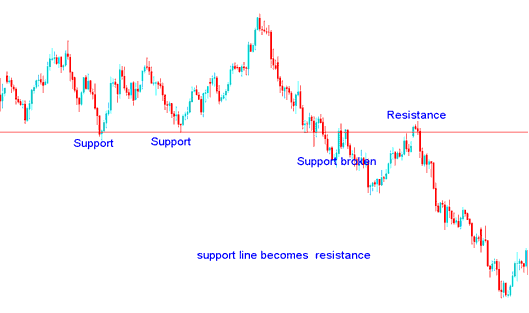
Support is broken it becomes a resistance
In the cryptocurrency trading example illustrated below, the support that had been tested two times could not hold the third time, the sellers were able to push the bitcoin price down past this level.
However, the bitcoin trading price bounced back up again, but this time the bitcoin trading price could not go up beyond this line. The bitcoin price was there after quickly pushed down by the sellers. This was because the line that was a support had now turned into a resistance.
In bitcoin trading when a support is taken out, the stop losses placed below that level are also taken out, thus reducing the momentum that the buyers had. This give sellers an opportunity to short sell bitcoin & place their stops just above this level which now turns into a resistance level.
Resistance is broken it becomes a support
In the cryptocurrency trading example illustrated below using the crypto chart, the resistance level that had been tested two times could not hold the third time, the bulls were able to push the bitcoin trading price up past this level.
When the bitcoin trading price tried to go down again it could not go lower than this level. The bitcoin trading price was there after quickly pushed further upwards by the buyers. This was because the line that was a resistance had now turned into a support. This is what happens in bitcoin trading, when a resistance level is broken it turn into a support level.
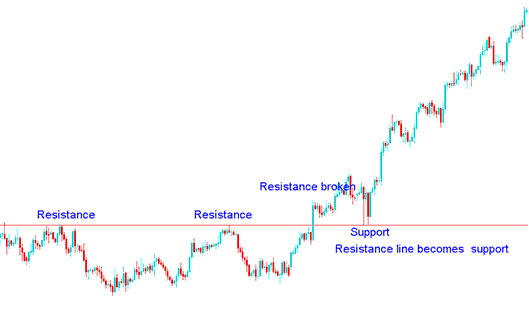
Traders who had closed their short sell cryptocurrency trades will now open long trades & place their stop losses just below this level.
Major and Minor Resistance Areas
In crypto charts the resistance and support levels formed are either major resistance/support points or minor resistance/support points.
Major Resistance/Support levels
In Major Resistance/Support levels bitcoin trading price will stay at this level for some time, either the bitcoin trading price will consolidate at this point or form a rectangle cryptocurrency chart pattern when bitcoin trading price gets to this point. This level will be tested several times before it is either broken or it holds and bitcoin price does not get to move past this resistance/support level.
The above example are good examples of major Resistance and Support Levels.
Minor Resistance/Support levels
In minor resistance and support points the bitcoin price will form these points quickly in the short term & then quickly move past these resistance regions & support regions.
Upward BTCUSD Trading Trend: The pattern of this minor resistance and support points will form a series of areas whose general direction is upwards.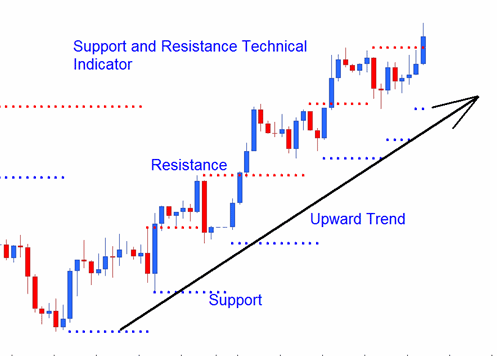
Upward Bitcoin Trend Series of Support & Resistance
Downward Bitcoin Trend: The pattern of this minor resistance and support points will form a series of areas whose general direction is downward.
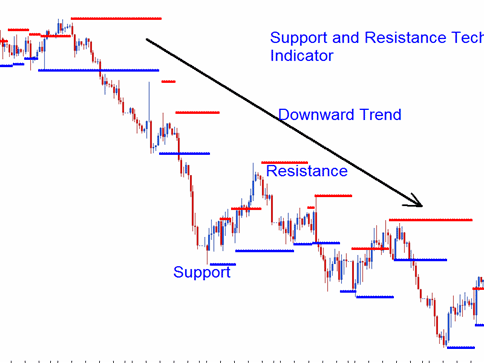
Downward Bitcoin Trend Series of Support & Resistance