What Happens After Coppock Curve Bullish Crossover Forex Trading Signal?
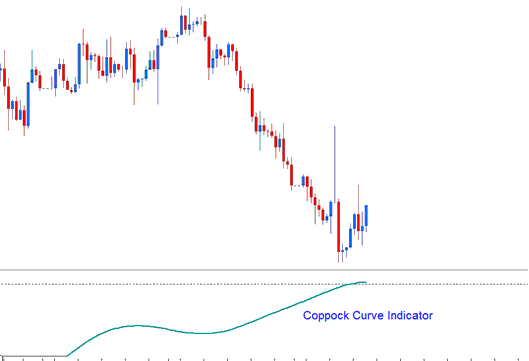
Coppock Curve Bullish Crossover Signal is a signal that shows the price of a forex currency pair is closing higher than it opened. Once there is a bullish Coppock Curve crossover signal the prices of the currency pair are expected to keep move in a bullish upward trend - this means that the prices are expected to keep closing higher.
The Coppock Curve bullish crossover signals - The average price of a currency pair will keep closing higher than it opened as long as the Coppock Curve bullish crossover signal remains bullish.
After Coppock Curve Bullish Crossover Signal - traders should open buy trades for that currency pair as this is a bullish trading signal.
If the Coppock Curve signals crosses below the Coppock Curve bullish crossover mark - then this shows that prices are no longer closing higher than they opened and the bullish momentum has reduced and traders should close their open buy trades if they had opened trades based on this Coppock Curve Bullish Crossover Signal.
Coppock Curve Bullish Crossover Forex Signal
Coppock Curve technical indicator was used for technical analysis of Stocks & Commodities in the beginning but was later used to trade Forex.
The principle behind this is the psychology of trading, based on the theory that human habit is predictable. And price movement always oscillates in a zigzag manner.
The principle of adaptation-level applies to how price reacts at certain levels, stock and currency prices will react in the same way or pattern as those observed historically.
FX Technical Analysis & Generating Signals
In Forex trading, The moving average is the simplest form of an adaptation-level, the price will oscillate around the moving average. This forms the basis of this indicator, which is a longer term oscillator based on this adaptation-levels(moving average), but in a different way.
Oscillators usually begin by calculating a % change of the current price from some previous price point, where the previous price point is the reference point (adaptation-level).
Edwin Coppock reasoned that the market participants' emotional state could be quantified by summing up the % changes over the recent past to get a general sense of the market's longer term momentum.
For example, If we compare prices relative to a year ago and we see that this month the market is up 20% compared to a year ago, last month it was up 15% over a year ago, and 10 %, 7.5% & 5% respectively the months before that, then we may determine that the market is gaining momentum.
Basic signals can also be generated using the Coppock Curve to trade market reversals from extreme price levels. Looking for divergence and trend line breaks may also be combined to confirm the signal.