Short Term Forex Trading with Moving Averages - Short Term Moving Averages Trading Strategies
Best Forex Strategies - Short Term Moving Averages Indicator Strategy
Short term moving averages sre moving averages that use shorter time periods as the settings for calculating these short term moving averages. By using short term periods to calculate the moving averages it means that the moving average indicator will react faster to price changes. Short term moving averages are used more by forex scalpers and day traders.
Short term forex trading will use short price periods such as the 10 and 20 moving average periods.
In the forex trading example below we use 10 and 20 Simple Moving Average to generate Forex signals: the forex trading signals generated are able to identify the forex trend as early as possible.
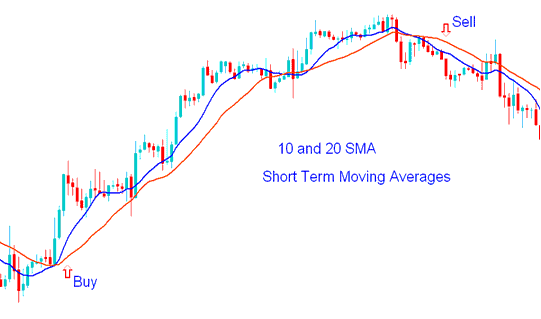
Short-term Forex Trading with Moving Averages - How to Trade Forex with Moving Averages Example
Scalper Forex Trader - Using Moving Averages
One of the most widely used method of forex technical analysis used to analyze forex chart trends in scalping forex trading is the use of moving averages.
The idea behind this moving average forex indicator is to simply enhance forex technical analysis before taking a forex trading signal to enter the market. Planning and setting forex trading goals in the short term according to moving average indicator helps a scalper forex trader to identify forex trends in the market and thus open forex orders accordingly.
Most of the forex trading signals can be established using a specific price period for the Moving Average Indicator. The forex Moving average indicator determines whether the trader will trade in the short-term or long-term. In addition, the forex price action is above or below this moving average indicator it determines the trend of the forex market for the day.
If a large part of the forex trading market price is considered to be below the Moving average indicator, then bias forex trend for the day is downwards. Most traders the use the MA as support or resistance to determine where to open a forex trade position, if price touches the MA in direction of the forex market trend a forex trade is then opened.
The forex moving averages are plotted and the intersection point with the forex price can be used to determine the appropriate entry and exit times in the FX trading market. Since there is always oscillation in the forex market trends and the market will repeat this process of oscillating and bouncing off the MA, this can be used to generate buy or sell signals.
Simple moving averages are calculated and their approach is based on the observation of the forex price within a particular period of time using sufficient data to calculate it. Their interpretation has provided many forex scalpers with lots of tips on how and when to open forex scalping trading.
Medium-Term Strategy
Medium term forex moving average strategy will use the 50 period MA.
The 50 period MA acts as support or resistance level for the forex price.
In an upward forex trend the 50 period MA will act as a support, forex price should always bounce back up after touching the MA. If the forex market closes below the indicator then this will be an exit signal.
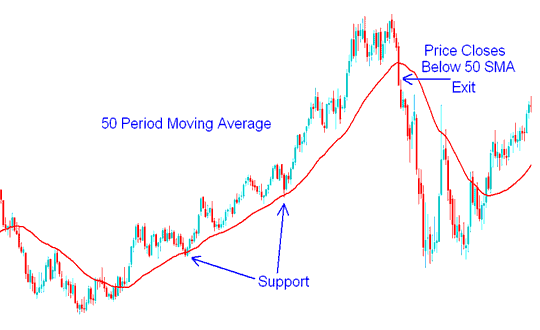
Forex Trading 50 Moving Average Period Support - Moving Average Forex Trading Strategy Examples
In a down forex trend the 50 period MA will act as a resistance, forex price should always go down after touching the moving average. If the forex market closes above this technical indicator then this is an exit signal.
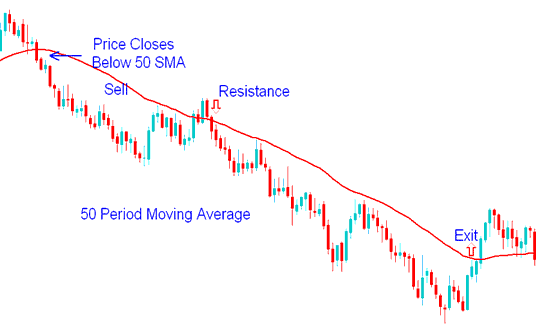
50 Moving Average Period Resistance - Forex Trading Strategies Examples
50 Day Moving Average Forex Technical Analysis
As the forex trend moves upwards, there is a key line you want to watch - this is the 50 day forex moving average. If the market stays above this 50 day forex moving average, that is a good signal. If the market drops below the 50 day forex moving average in heavy volume, then watch out, because there could be forex trend reversal signal ahead.
A 50 day MA forex indicator takes 10 weeks of forex market data, & then plots the average. Moving line is recalculated everyday. This will show the forex trend - it can be up, down, or sideways.
You normally should only buy when prices are above their 50 day forex MA. This tells you the current forex market direction is trending upward. You always want to trade with the forex trend, and not against it. Many forex traders only open orders in direction of the trend.
Forex prices normally will find support over and over again at this 50 day forex moving average. Big investing institutions watch this level closely. When these big volume entities spot a forex trend moving down to its 50 day line, they see it as an opportunity, to add to their trade position, or start a new forex trade position at a reasonable level.
What does it mean if your forex currency pair moves downward and slices through its 50 day line. If it happens on heavy volume, it is a strong forex signal to sell. This means big institutions are selling their share, and that can cause a dramatic drop in price, even if fundamentals still look solid. Now, if your forex currency pair drops slightly below the 50 day line on light volume, watch how it acts in the following days, and take appropriate action if necessary.
Long-Term Strategy
Long term forex trading strategy will use long period such as the 100 and 200 MAs which act as long term support and resistance levels for the price. Since many traders use these 100 and 200 forex moving averages, the price will often react to these support and resistance areas.
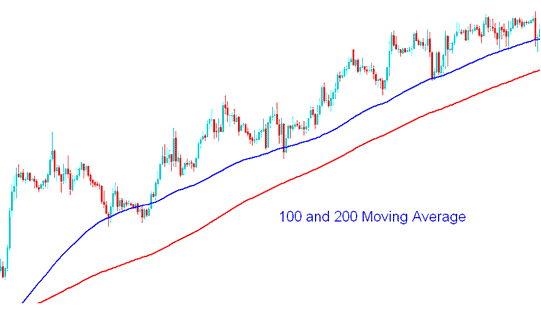
100 & 200 MAs - How to Trade Forex Using Moving Average Strategies
In Forex, traders can use both fundamental analysis and technical analysis to help determine whether a forex currency pair is a good buy or sell.
In forex technical analysis technique forex traders looking to gauge supply and demand for a forex currency pair use the 200 day moving average to examine data in different ways.
Forex traders are most familiar with the basic forex technical analysis of the 200 day MA is used to plot the long term support or resistance level. If forex market price is above 200 day MA then the trend is bullish, and if it is below it then forex trend is bearish.
One of the ways to measure supply and demand in forex trading is to calculate the average closing price over the last 200 sessions. This trading moving average accounts for each day going back in time & shows you how this 200 day average has moved.
The reason why the average 200 day MA in particular is so popular in forex technical analysis is because historically has been used and it produces good results for trading in the exchange market. A popular timing forex strategy is used to buy when the forex market is above its moving average of 200 days and sell when it goes below it.
With this moving average forex indicator, forex traders can benefit from being notified when a forex currency pair rises above, or falls below its 200 day Moving Average and then traders can then use their technical analysis to help determine if the forex trading signal is an opportunity to go long or short.