Trailing Stop CFD Orders CFD
A trailing stop loss order setting level can be calculated using cfd indicators such as the Parabolic SAR indicator.
If the cfd market rises by a set number of pips the parabolic SAR indicator then adjusts the trailing stop loss level upwards accordingly.
Also if the cfd market falls by a set number of pips the parabolic SAR indicator then adjusts the trailing stop loss level downwards accordingly.
Parabolic SAR Indicator
Parabolic SAR is used by traders to set a trailing cfd price stoploss areas
The Parabolic SAR provides good exit points that keep trailing the cfd price on a cfd chart.
In an upward cfd trend, you should close long trades when the price drops below the parabolic SAR
In a downward cfd trend, you should close short trade positions when the price rises above the parabolic SAR.
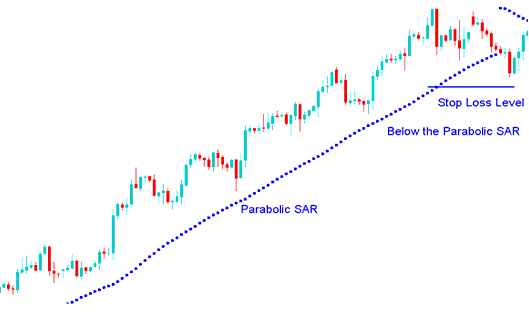
Parabolic SAR - CFDs Technical Indicator for Setting Trailing Stop Loss CFD Order Levels
Bollinger Bands Indicator
Bollinger bands cfd technical indicator use standard deviation as a measure of volatility. Since standard deviation technical indicator is a measure of volatility, the bands are self adjusting meaning they widen during periods of higher volatility and contract during periods of lower volatility.
Bollinger Bands consist of 3 bands designed to encompass the majority of a trading instruments cfd price action. The middle band is the basis for the intermediate trend, mostly it is a 20 day period simple moving average, which also serves as the base for calculating the upper band and lower band. The upper band's and the lower band's distance from the middle band is determined by price volatility.
Since these bollinger bands are used to encompass the trading instrument cfd price action, the bollinger bands can be used by traders to set stop loss orders just outside the areas of the bands.
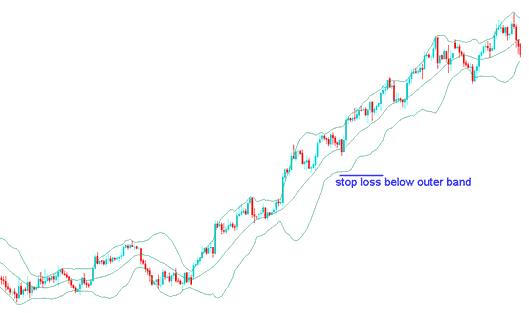
Bollinger Bands CFDs Indicator - Setting Trailing Stop Loss CFD Order Level using Bollinger Bands Indicator